
I’ll start by stating the obvious: we live in a time where ultra-powerful, always-connected computers fit in the palms of our hands. These devices endlessly stream our physical and digital patterns of life – our POL. And in many cases, that timeline of captured moments starts with a newborn baby. We message friends, track our health, navigate cities and countries, share milestones, and scroll through each other’s worlds. It’s all so natural now that we rarely stop to think about it.
Not long ago, our lives were mostly private. What we did, where we went, what we believed – those things were shared sparingly, with people we trusted. Today, we’ve been conditioned to share them all. The more people see, the more engagement we earn. Somewhere along the way, visibility replaced privacy as a measure of value.
That’s the quiet shift I’ve watched unfold over the past two decades; one that defines our digital era, enabled by the evolution of hardware and code. We’re no longer just using these devices; we’re training them to understand us. And in return, they’ve trained us to share. Every time we unlock our phones, navigate a route, or post a moment online, we feed the most sophisticated data ecosystem on the planet.
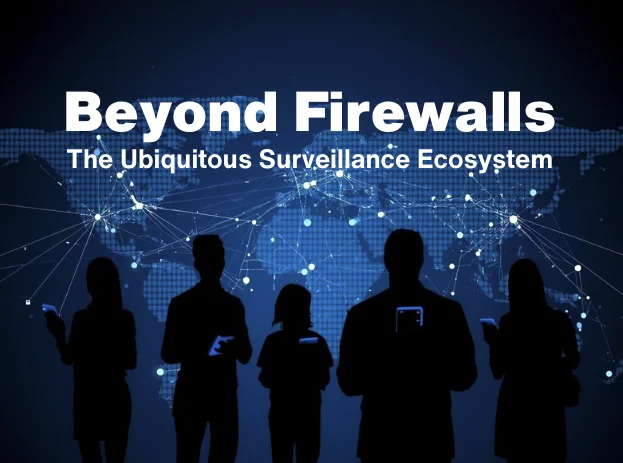
This is what I call the Ubiquitous Surveillance Ecosystem (USE) – a digital environment where nearly every action, choice, and preference leaves a trace. Each trace seems harmless on its own, but together they tell a story so complete, it’s become predictive.
I started CohēCiv because I see how unprepared most people and organizations are for that reality. Firewalls, antivirus software, and encryption still matter. But they no longer define the perimeter. The true perimeter is human behavior.
This article launches a new series I’m calling Beyond Firewalls – a collection of insights meant to help leaders, operators, and professionals understand the digital landscape (read: battlespace) we all inhabit. Whether you work in defense, law enforcement, the private sector, or even humanitarian operations, the terrain has changed – and so must the way we think about exposure.
The New Digital Battlefield
The digital threat landscape has evolved beyond what most security doctrines were built to handle. It’s not just about breaches or malware anymore – it’s about commercial data collection, constant connectivity, and the way our everyday behaviors feed invisible systems of observation.
In traditional espionage, access and intent were the main barriers. Today, an adversary can often buy the same insights that once required infiltration or tradecraft.
AdTech firms, data brokers, and sensor-rich devices now collect and combine data to map patterns of life with astonishing precision. What began as tools for personalization has evolved into engines of prediction, and in the wrong hands, prediction becomes exploitation.
For those of us in national security, this is a new kind of battlespace. For businesses, it’s an unrecognized front line in corporate resilience. Either way, the contest is no longer for access to data – it’s for control of the narrative that data builds.
From Data to Behavior
When people talk about cybersecurity, they usually talk about infrastructure – networks, systems, endpoints. But I’ve come to believe the most significant vulnerabilities aren’t in code or hardware; they’re in human behavior.
Our routines and digital habits – the apps we favor, the routes we drive, the hours we’re active – create a rhythm. Over time, that rhythm becomes predictable. Predictability is intelligence gold.
With CohēCiv, I focus on that human dimension – how digital behavior scales into organizational exposure. Because it always does.
Understanding psychographics – the “why” behind decisions and digital patterns – is just as important as understanding the data itself. When an adversary can map not just your location but your motivation, they don’t need to hack your systems. They can anticipate, and often manipulate, your next move.
That’s why I believe that in this era, understanding behavior is equivalent to understanding vulnerability.
Mapping the Modern Exposure
The USE isn’t a single system. It’s an overlapping web of what I describe as Ambient Data Surveillance (ADS) and what the intelligence community knows as Ubiquitous Technical Surveillance (UTS).
- ADS is a passive and continuous collection of personal data through digital and physical environments, often without explicit user consent. Leveraging smartphones, Internet-of-Things (IoT) devices, and online interactions, this data is used to map behaviors, predict trends, and drive influence operations.
- UTS is the pervasive and often covert monitoring of individuals and organizations across digital, electronic, and physical spaces. Enabled by sensors and real-time data collection, UTS serves intelligence, security, and commercial interests.
Together, they form a kind of ambient intelligence that never shuts off.
And here’s the uncomfortable truth: this system doesn’t care who you are. A general officer, a CEO, a field worker, or a private citizen – all leave digital signatures that can be observed, modeled, and exploited.
The line between personal and professional life has dissolved. A spouse’s app, a child’s social media post, even a travel itinerary can feed into an adversary’s picture of your organization. Exposure has become communal.
Beyond Firewalls: A Human-Centric Defense
In my work, I often tell clients that true digital resilience begins not with technology, but with self-awareness.
At CohēCiv, I teach that defending against digital threats means understanding the human factors that generate them – the habits, behaviors, and assumptions that create patterns adversaries can use.
Our goal isn’t to eliminate risk. It’s to recognize it – to understand the behavioral terrain we move through and make smarter, more deliberate choices within it.
That’s what I mean by going beyond firewalls.
What Comes Next
This series will dive deeper into the components of the Ubiquitous Surveillance Ecosystem:
- How Ambient Data Surveillance (ADS) turns everyday convenience into collection,
- How Ubiquitous Technical Surveillance (UTS) has blurred the line between espionage and normal life,
- And how industries – from law enforcement to NGOs to property management – can learn to navigate this invisible battlespace.
Each post will focus on practical, behavioral insights that leaders can apply immediately.
Because before we can defend data, we have to understand ourselves as data.
This article is part of Beyond Firewalls, a thought-leadership series by Keola Rogers, founder of CohēCiv LLC, exploring the human dimension of digital risk and the modern surveillance ecosystem.
Comments are closed